
Butt Fusion Joint Solutions
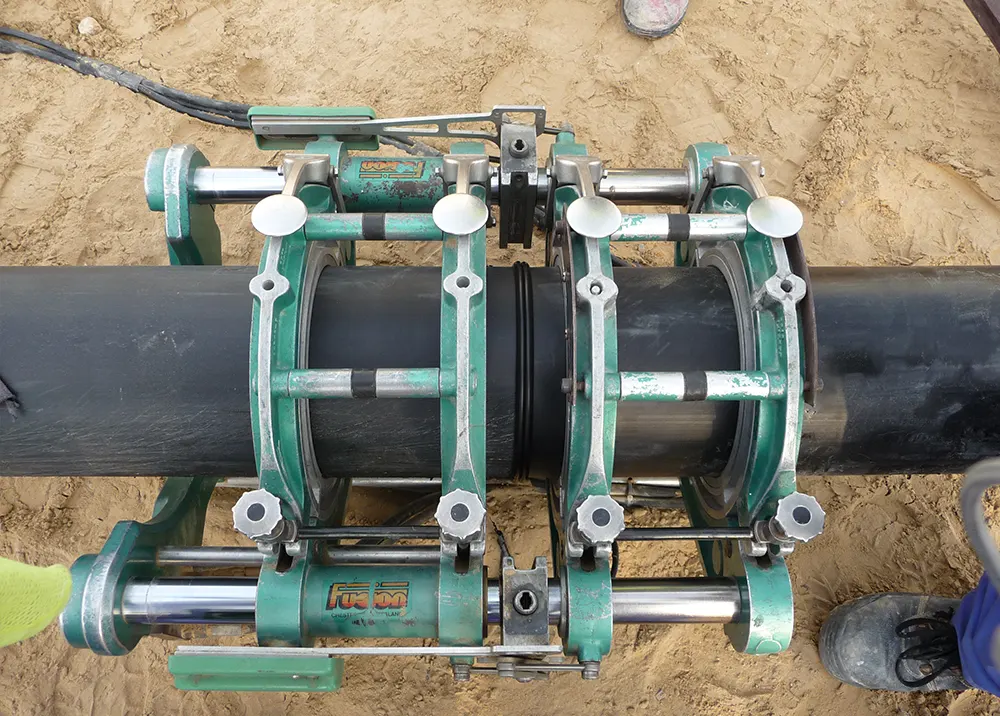
Butt Fusion joint process is the most important and widely used method of connection for HDPE pipes. It is a method of jointing pipe ends by way of heating and cooling under pressure, resulting in pipe joints as strong as the pipe itself. The principle of butt fusion is to heat the pipe ends with heater plate to a designated temperature and pressure for a specified amount of time, then the pipe ends are fused together under pressure for a period of time.
Butt Fusion Jointing Process
Integral Pipeline follows industry-approved procedures to ensure joint integrity:
Pipe end alignment and clamping
Facing of pipe ends for smooth and square surfaces
Heating of pipe ends using a calibrated heater plate
Fusion of heated pipe ends under controlled pressure
Cooling under pressure to achieve joint strength
Visual inspection and quality verification
All butt fusion works are carried out using certified equipment and trained operators.
Various flange types and pressure ratings are available, depending on service conditions, operating pressure, and application requirements.
Applications of Butt Fusion Joints
Butt fusion jointing is widely used in:
HDPE water transmission pipelines
Gas distribution networks
Sewer and drainage systems
Industrial process pipelines
Underground and above-ground HDPE pipelines
Advantages of Butt Fusion Joints
Joint strength equal to the pipe material
Fully leak-proof and homogeneous joint
No fittings or adhesives required
Excellent resistance to corrosion and chemicals
Suitable for high-pressure applications
Long service life with minimal maintenance
Why Choose Integral Pipeline?
Expertise in FRP – HDPS pipeline jointing systems
Skilled installation teams
Compliance with international standards
Proven experience in buried pipeline projects
Reliable and cost-effective execution
Integral Pipeline delivers safe, durable, and efficient jointing solutions for demanding pipeline applications.
A Flanged Joint is a restrained piping connection where two flanges are bolted together with a gasket in between, creating a secure and leak-proof joint that can be easily assembled and disassembled.
Flanged joints are widely used to connect pipelines to valves, pumps, tanks, and other equipment, as well as for joining pipelines made of different materials in industrial and utility systems.
Yes. Flanged joints are available in various pressure ratings and designs. Proper gasket selection, alignment, and controlled bolt tightening are essential to ensure safe performance under pressure.
Excessive misalignment can introduce high stresses in the joint, leading to leakage or premature material failure. Proper alignment ensures even load distribution and long-term joint reliability.