
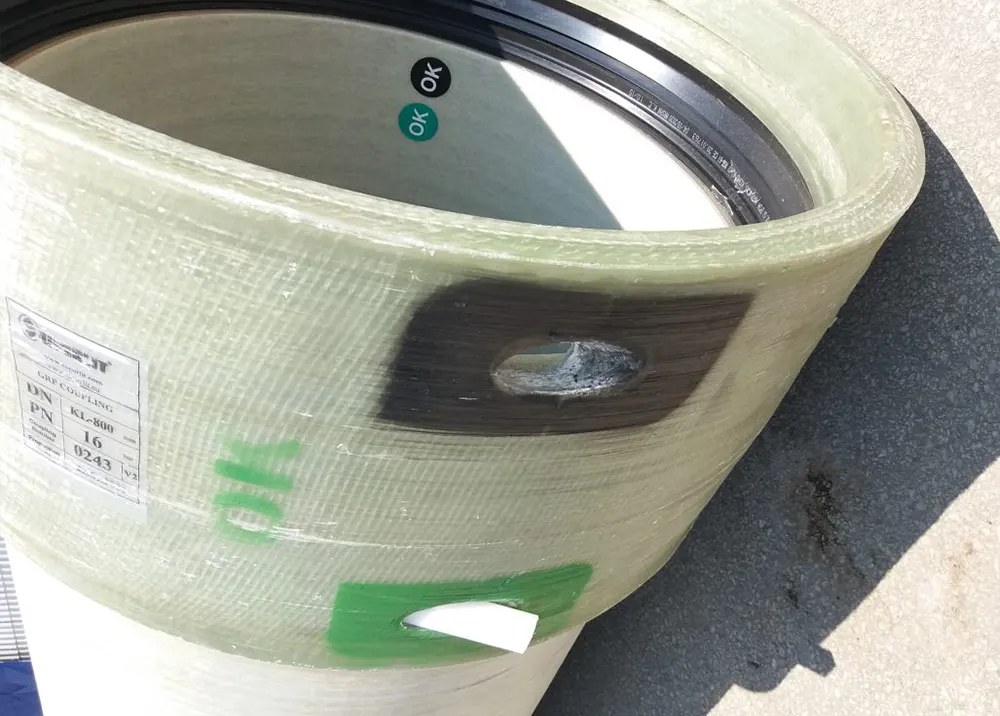
DOUBLE BELL COUPLING JOINT
The mechanical O-ring lock joint is a tensile resistant type of joint. The locking device, which provides longitudinal thrust restraint is inserted into a groove through an opening and can be removed to disassemble the joint at some later stage. Shear resistant plastic material is used for the locking strip.
What is a Double Bell Coupling Joint?
A Double Bell Coupling Joint is an unrestrained jointing system used to connect:
A socket end to a spigot end, or
Two spigot ends using a double bell coupling
Hydraulic sealing is achieved using elastomeric rubber rings placed in circumferential grooves inside the socket and coupling. These rubber rings provide a tight, leak-proof seal while allowing limited movement.
Double Bell Coupling Jointing Process
Integral Pipeline follows standard installation practices to ensure joint reliability:
Preparation and alignment of pipe ends
Placement of elastomeric rubber rings in designated grooves
Insertion of spigot ends into the socket or coupling
Verification of correct joint assembly and sealing
Installation of concrete thrust blocks at directional changes
All works are carried out as per project specifications and pipeline standards.
Applications of Double Bell Coupling Joints
This jointing method is ideal for:
Buried FRP / GRP / Fiberglass pipelines
Long straight pipeline runs
Water transmission and drainage systems
Industrial utility pipelines
Infrastructure and utility projects
Why Choose Integral Pipeline?
Expertise in FRP pipeline jointing systems
Skilled installation teams
Compliance with international standards
Proven experience in buried pipeline projects
Reliable and cost-effective execution
Integral Pipeline delivers safe, durable, and efficient jointing solutions for demanding pipeline applications.
A Double Bell Coupling Joint is an unrestrained jointing system used to connect FRP / GRP pipelines by joining a socket and spigot or two spigot ends using a double bell coupling with elastomeric rubber rings for hydraulic sealing.
Where are Double Bell Coupling Joints commonly used?
No. Double bell coupling joints are unrestrained and cannot withstand longitudinal forces. Concrete thrust blocks are required at bends, tees, valves, and directional changes to ensure pipeline stability.